Does Nail Polish Expire? Shelf Life, Safety & Storage Tips
Nail polish does expire in the practical sense: its formula eventually loses stability and stops applying properly. Regular lacquer usually thickens or becomes uneven as solvents evaporate. UV gel polish raises a separate safety concern because incomplete curing can leave irritating monomers on the nail. Storage, bottle age, formula type, smell and texture all matter when deciding whether to use it.
Nail Polish Shelf Life by Type
| Polish type | Opened shelf life | Unopened shelf life | Key condition | Signs of spoilage | Revival method |
|---|---|---|---|---|---|
| Regular nail lacquer | 18–24 months | 2–3 years | Cool, dark, tightly sealed | Separation, lumps, stringy texture | 2–3 drops polish thinner |
| Fast-drying lacquer | 12–18 months | 2–3 years | Minimize solvent evaporation | Thickening, strings, rapid drying | Polish thinner; never acetone |
| UV gel polish | 24–36 months | 3–4 years | Opaque, light-protected storage | Curing in bottle, clumps, separation | Do not thin; discard if cured |
| Essie Nail Color | 18–24 months | 2 years | Upright, away from humidity | Thickening, separation, uneven application | Polish thinner; never acetone |
| Thermal/color-changing lacquer | 6–18 months | 2 years | Dark, temperature-stable storage | Faded color shift, separation, lumps | Polish thinner if lacquer-based |
| Chrome/metallic lacquer | 12–24 months | 2–3 years | Tightly sealed; prevent settling | Settled particles, clumps, dull finish | Roll bottle gently; use polish thinner |
These ranges are practical estimates, not automatic discard dates. Unopened regular lacquer generally lasts 2-3 years, while opened regular lacquer typically lasts 18-24 months. Storage and the bottle’s condition still matter. Discard it if it develops persistent separation, lumps or a stringy texture.
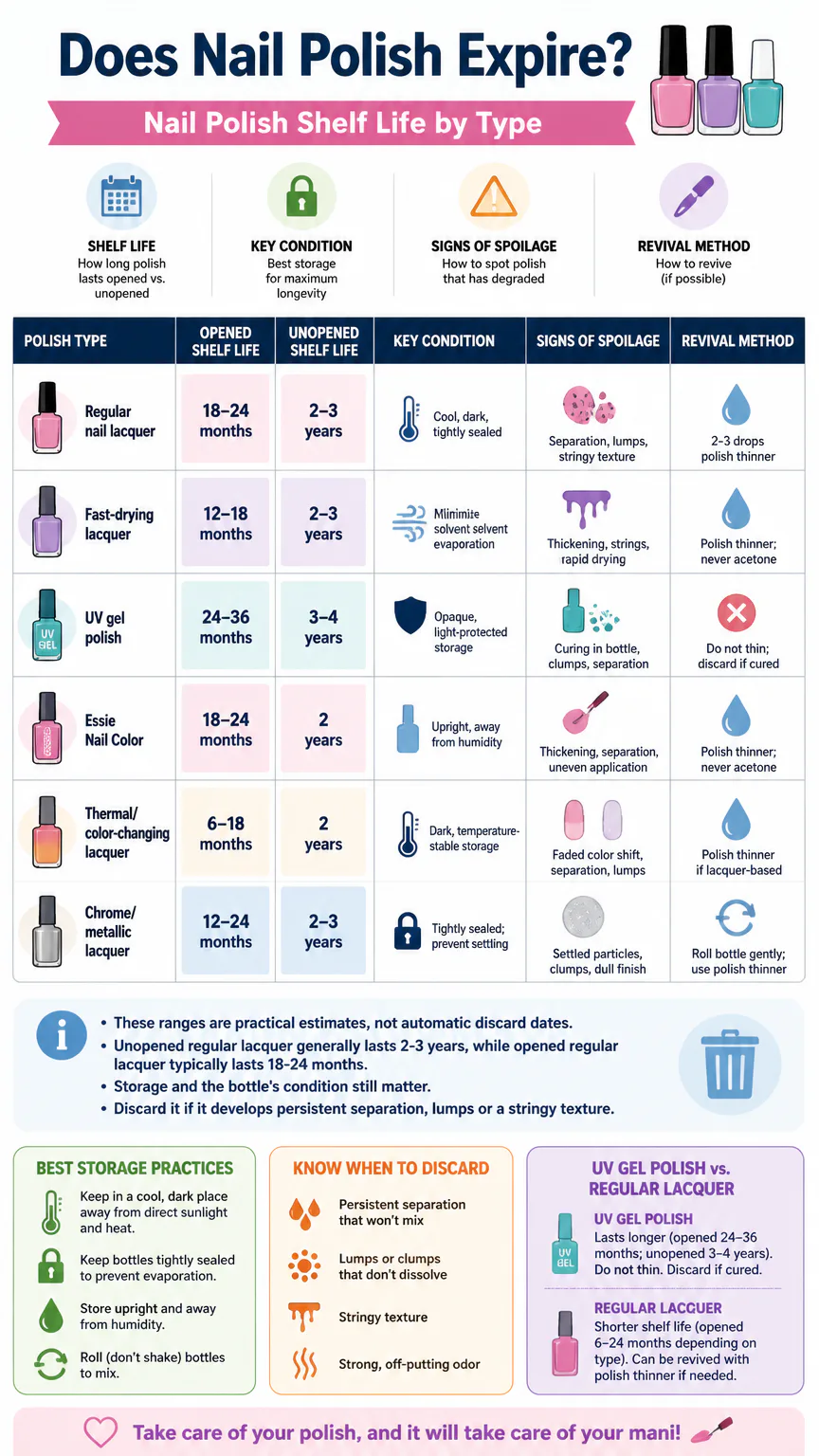
Does nail polish expire?
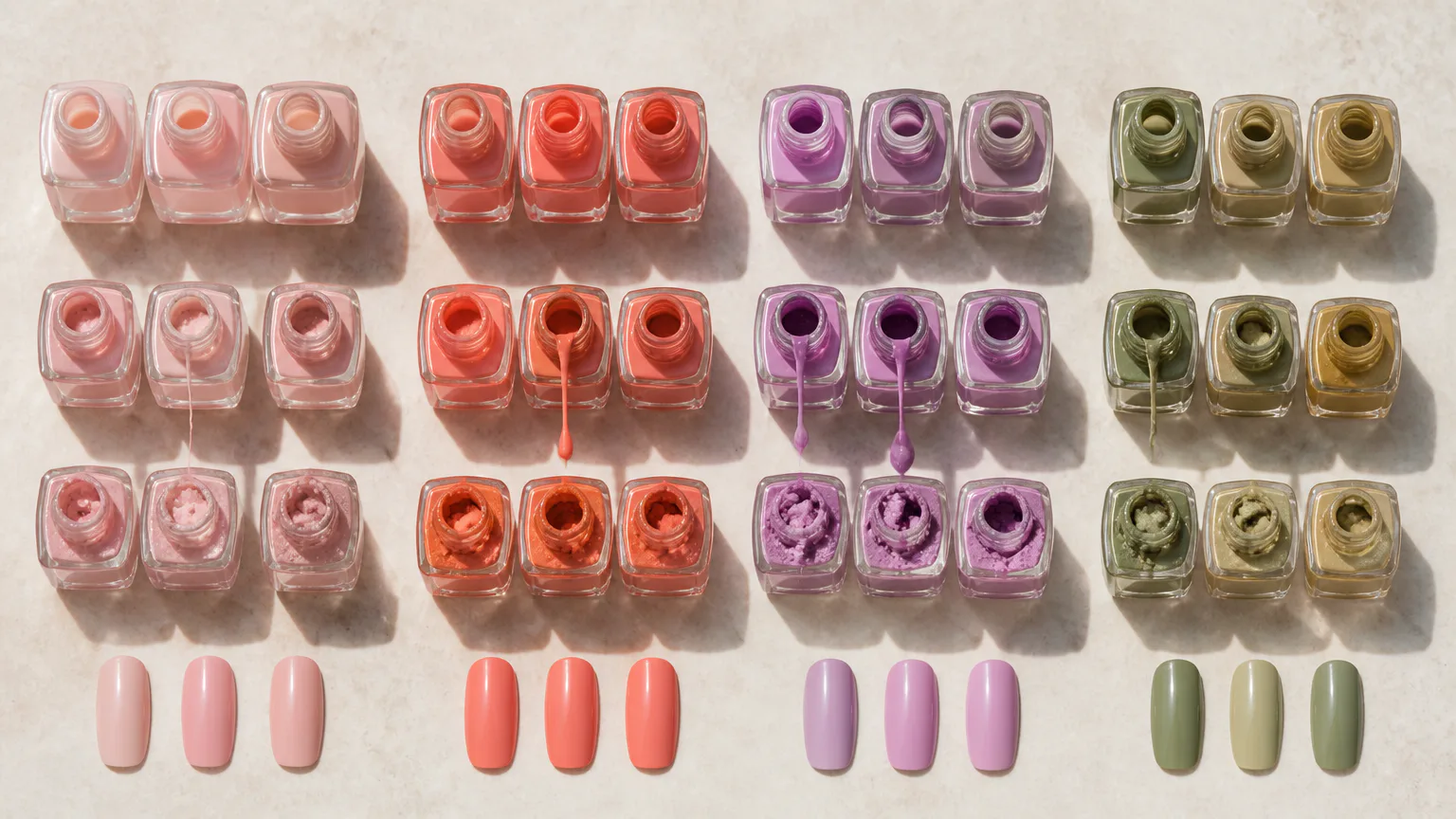
Regular nail polish does not spoil like food. Its solvents gradually evaporate, especially when the bottle is opened repeatedly, leaving the pigments, resins and other ingredients more concentrated. The usual result is poor performance rather than bacterial contamination or toxicity.
Fast-drying formulas often reach this stage sooner because their solvent balance is meant to evaporate quickly during application. The PAO symbol, shown as an open jar marked 12M or 24M, indicates the recommended period after opening. It is useful guidance, but the bottle’s actual condition matters more.
Unopened polish usually lasts longer because the cap has not allowed regular solvent exchange. Regular lacquer generally keeps for 2-3 years unopened. Heat, direct sunlight, temperature swings, and a loose or contaminated cap can shorten that period. A bottle that smells normal, mixes smoothly and applies evenly may still be usable near the end of the range. Persistent separation, lumps or stringiness are warning signs.
How to spot expired polish
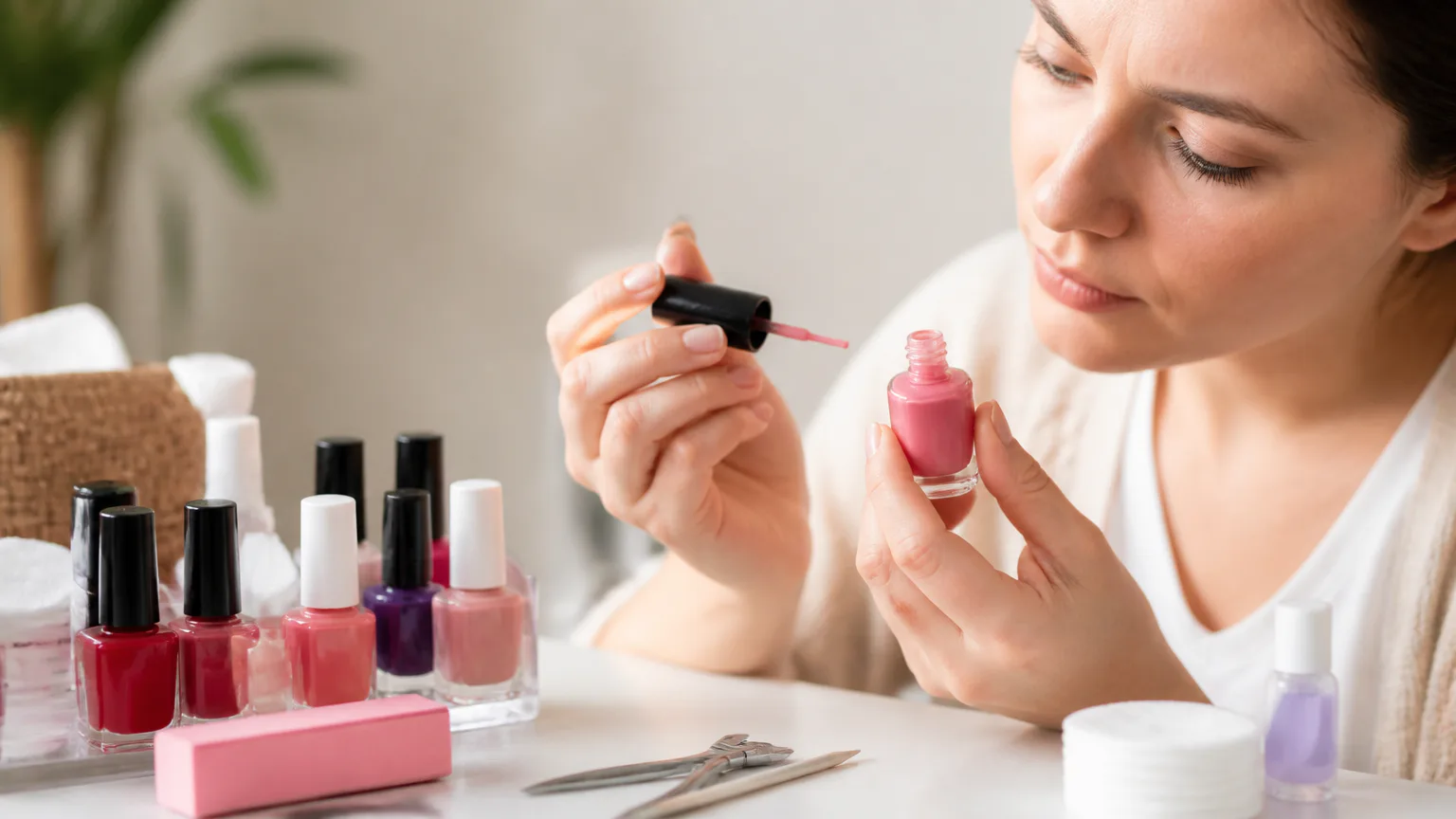
Inspect an old bottle before applying it. Roll it gently between your palms to remix the contents, then brush a small amount onto a disposable surface or one nail. Do not shake it first; shaking introduces air bubbles that can make usable polish appear defective.
- Texture: Thick, stringy, gummy, clumpy or difficult-to-pull polish indicates solvent loss or formula breakdown.
- Separation: Pigment separation is normal if the layers remix smoothly after gentle rolling. Separation that returns immediately is a warning sign.
- Color: Fading, darkening or an unexpected color change can indicate age or light damage.
- Odor: A sharp, sour, vinegary or otherwise unusual smell means the bottle should be discarded.
- Drying: Polish that stays wet unusually long or dries unevenly may no longer have the right solvent balance.
- Application: Streaks, bald patches, heavy dragging or persistent lumps show that the formula is no longer performing properly.
A small amount of normal separation is not enough to condemn a bottle. If the polish rolls smooth, smells normal and forms an even coat that dries properly, it may still be usable even when it is older than the usual recommendation.
Can you use expired polish safely?
Old regular lacquer is usually a performance problem rather than a serious toxicity problem. It may look uneven, take longer to dry, peel quickly or feel difficult to remove. Do not use it if the smell is abnormal, the contents remain clumped or the bottle causes burning or irritation.
UV gel polish requires more caution because it must cure fully under the lamp specified for its formula. A compatible UV lamp usually cures gel in about two minutes per coat. A compatible LED lamp commonly cures each layer in 30-60 seconds. Older lamps can also weaken over time: fluorescent UV bulbs may need replacement every few months as their intensity declines.
| Polish type | Main aging problem | Decision rule |
|---|---|---|
| Regular nail lacquer | Thickening and poor application | Use only if normal in smell and texture |
| UV gel polish | Incomplete curing | Discard if curing is uncertain |
Uncured gel can leave monomers against the skin and increase the risk of contact allergy. Itching, redness, blisters, dryness, cracking or nail lifting called onycholysis are reasons to remove the product and stop using it. Persistent symptoms need medical attention.
How to restore thick polish
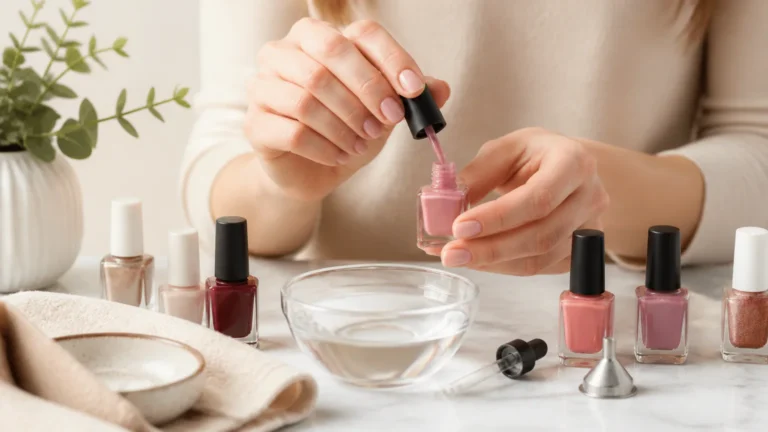
Nail polish thinner can restore mildly thickened regular lacquer by replacing some lost solvent. It cannot reliably repair polish that is stringy, foul-smelling, permanently clumped or chemically altered.
- Remove dried polish from the bottle neck and brush threads.
- Add two or three drops of nail polish thinner.
- Close the cap tightly.
- Roll the bottle gently between your palms for 15-30 seconds.
- Test a thin coat and add another small amount only if necessary.
Do not use nail polish remover as a thinner. Acetone-based remover can break down the lacquer’s formula, change its drying behavior and leave an unreliable finish. Thinner is appropriate for regular lacquer; it is not a substitute for correct curing and is not a compatible product for UV gel.
A few drops of nail polish thinner may restore the consistency, but thickened polish can still apply less evenly than a fresh bottle. Use thin coats, keep the brush lightly loaded, and let each layer dry before applying the next. These steps help you apply nail polish cleanly and reduce dragging and bubbling.
How to store nail polish
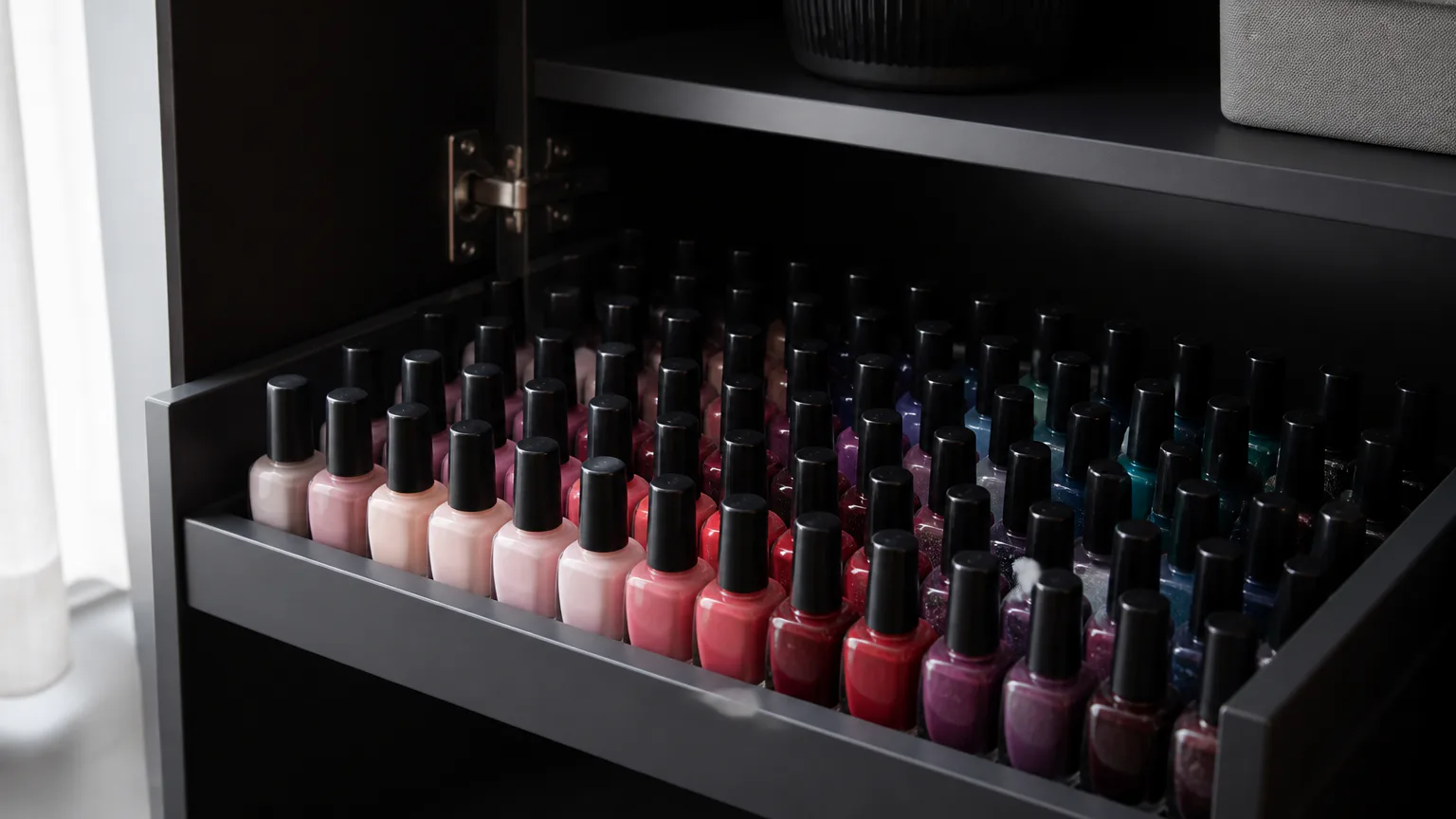
Storage affects how quickly solvents escape and pigments change. Keep bottles upright in a cool, dry, dark drawer, cabinet or closet. A stable room-temperature location is better than an area exposed to sunlight, heaters or repeated temperature changes.
- Close the cap immediately after loading the brush.
- Wipe the bottle neck clean before sealing it.
- Keep bottles upright so polish does not collect around the cap.
- Store gel polish away from daylight and other strong light sources.
- Avoid bathrooms, where humidity and temperature fluctuations are common.
- Keep polish away from heat, flames and ignition sources.
A clean bottle rim helps the cap form an airtight seal. Do not leave the cap loosely attached while painting, and do not store nail polish in a hot car or on a sunny windowsill.
When to replace or dispose of polish
Replace regular polish when it remains gummy after adding thinner, develops an unusual odor, cannot be mixed smooth or repeatedly produces a poor finish. Replace UV gel when its age, texture, curing behavior or lamp compatibility creates doubt. A low-cost bottle is not worth keeping if it exposes skin to uncured gel or causes repeated failed applications.
Do not pour liquid nail polish or acetone-based remover down a drain, and do not place liquid or unusable bottles in regular curbside trash. In the United States, take them to a local Household Hazardous Waste facility or a designated household hazardous-waste collection event. Keep containers closed during transport and follow the facility’s packaging instructions.
If a bottle stays stringy after thinning, keeps separating, or develops an unusual smell, replace it rather than trying to salvage it. A fresh formula should be smooth, the cap should close securely, and the brush should apply thin, even coats. Look for those features when choosing from the best nail polish options.
FAQs
Can you use 10-year-old nail polish?
A 10-year-old regular polish is well beyond the typical shelf life of about 2-3 years unopened and 18-24 months after opening. Replace it rather than relying on smell or texture alone, especially if it is thick, clumped, unusually odorous or difficult to apply.
Can you use 20-year-old nail polish?
Twenty-year-old nail polish is far beyond the typical 2-3-year unopened shelf life and should be discarded, even if the bottle appears sealed. Do not use it if the seal is damaged, the formula has separated permanently or the smell, color or texture has changed.
Does nail polish remover expire?
Acetone-based nail polish remover can remain usable indefinitely when tightly sealed and stored in a cool, well-ventilated place away from heat and open flames. Discard it through a Household Hazardous Waste facility if the container is damaged or the liquid is contaminated.
How long does polish last with a top coat?
A top coat can extend how long a manicure lasts on the nail, but it does not prevent solvent loss or formula aging inside the polish bottle.
A top coat can help a manicure last longer, but it cannot prevent lifting when the polish underneath is old, thick or applied in heavy layers. Seal the nail tip, keep each coat thin and allow enough drying time for the best chance to prevent nail polish chipping.
Conclusion
Judge regular nail polish by its smell, texture and application rather than age alone. Use thinner only for mildly thickened lacquer, treat UV gel curing problems seriously, and take unusable liquid products to a Household Hazardous Waste facility instead of pouring them down a drain or placing them in a curbside bin.