Nail Polish Finishes Explained: Find Your Perfect Finish
Nail polish finish affects how a color reflects light, how much of the natural nail remains visible, and whether the surface feels smooth or textured. The same shade can look very different as a crème, jelly, glitter, or chrome polish. Coverage, shine, removal time, and the manicure style you want all matter when choosing a finish—pair this with how to choose nail polish color and the ILNP finishes guide.
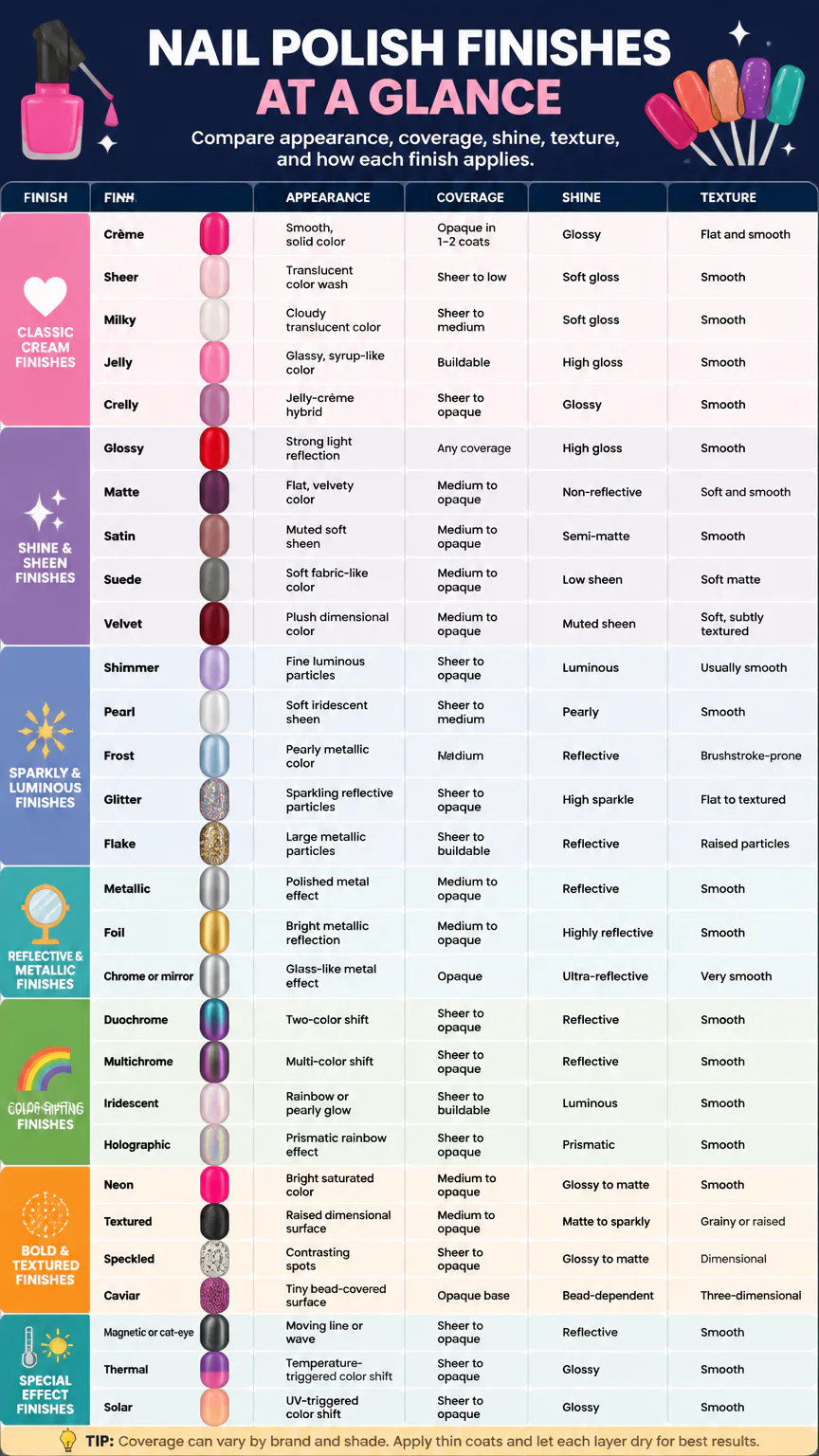
Nail Polish Finishes at a Glance
| Finish | Appearance | Coverage | Shine | Texture |
|---|---|---|---|---|
| Crème | Smooth, solid color | Opaque in 1–2 coats | Glossy | Flat and smooth |
| Sheer | Translucent color wash | Sheer to low | Soft gloss | Smooth |
| Milky | Cloudy translucent color | Sheer to medium | Soft gloss | Smooth |
| Jelly | Glassy, syrup-like color | Buildable | High gloss | Smooth |
| Crelly | Jelly-crème hybrid | Sheer to opaque | Glossy | Smooth |
| Glossy | Strong light reflection | Any coverage | High gloss | Smooth |
| Matte | Flat, velvety color | Medium to opaque | Non-reflective | Soft and smooth |
| Satin | Muted soft sheen | Medium to opaque | Semi-matte | Smooth |
| Suede | Soft fabric-like color | Medium to opaque | Low sheen | Soft matte |
| Velvet | Plush dimensional color | Medium to opaque | Muted sheen | Soft, subtly textured |
| Shimmer | Fine luminous particles | Sheer to opaque | Luminous | Usually smooth |
| Pearl | Soft iridescent sheen | Sheer to medium | Pearly | Smooth |
| Frost | Pearly metallic color | Medium | Reflective | Brushstroke-prone |
| Glitter | Sparkling reflective particles | Sheer to opaque | High sparkle | Flat to textured |
| Flake | Large metallic particles | Sheer to buildable | Reflective | Raised particles |
| Metallic | Polished metal effect | Medium to opaque | Reflective | Smooth |
| Foil | Bright metallic reflection | Medium to opaque | Highly reflective | Smooth |
| Chrome or mirror | Glass-like metal effect | Opaque | Ultra-reflective | Very smooth |
| Duochrome | Two-color shift | Sheer to opaque | Reflective | Smooth |
| Multichrome | Multi-color shift | Sheer to opaque | Reflective | Smooth |
| Iridescent | Rainbow or pearly glow | Sheer to buildable | Luminous | Smooth |
| Holographic | Prismatic rainbow effect | Sheer to opaque | Prismatic | Smooth |
| Neon | Bright saturated color | Medium to opaque | Glossy to matte | Smooth |
| Textured | Raised dimensional surface | Medium to opaque | Matte to sparkly | Grainy or raised |
| Speckled | Contrasting spots | Sheer to opaque | Glossy to matte | Dimensional |
| Caviar | Tiny bead-covered surface | Opaque base | Bead-dependent | Three-dimensional |
| Magnetic or cat-eye | Moving line or wave | Sheer to opaque | Reflective | Smooth |
| Thermal | Temperature-triggered color shift | Sheer to opaque | Glossy | Smooth |
| Solar | UV-triggered color shift | Sheer to opaque | Glossy | Smooth |
Classic and Natural Finishes
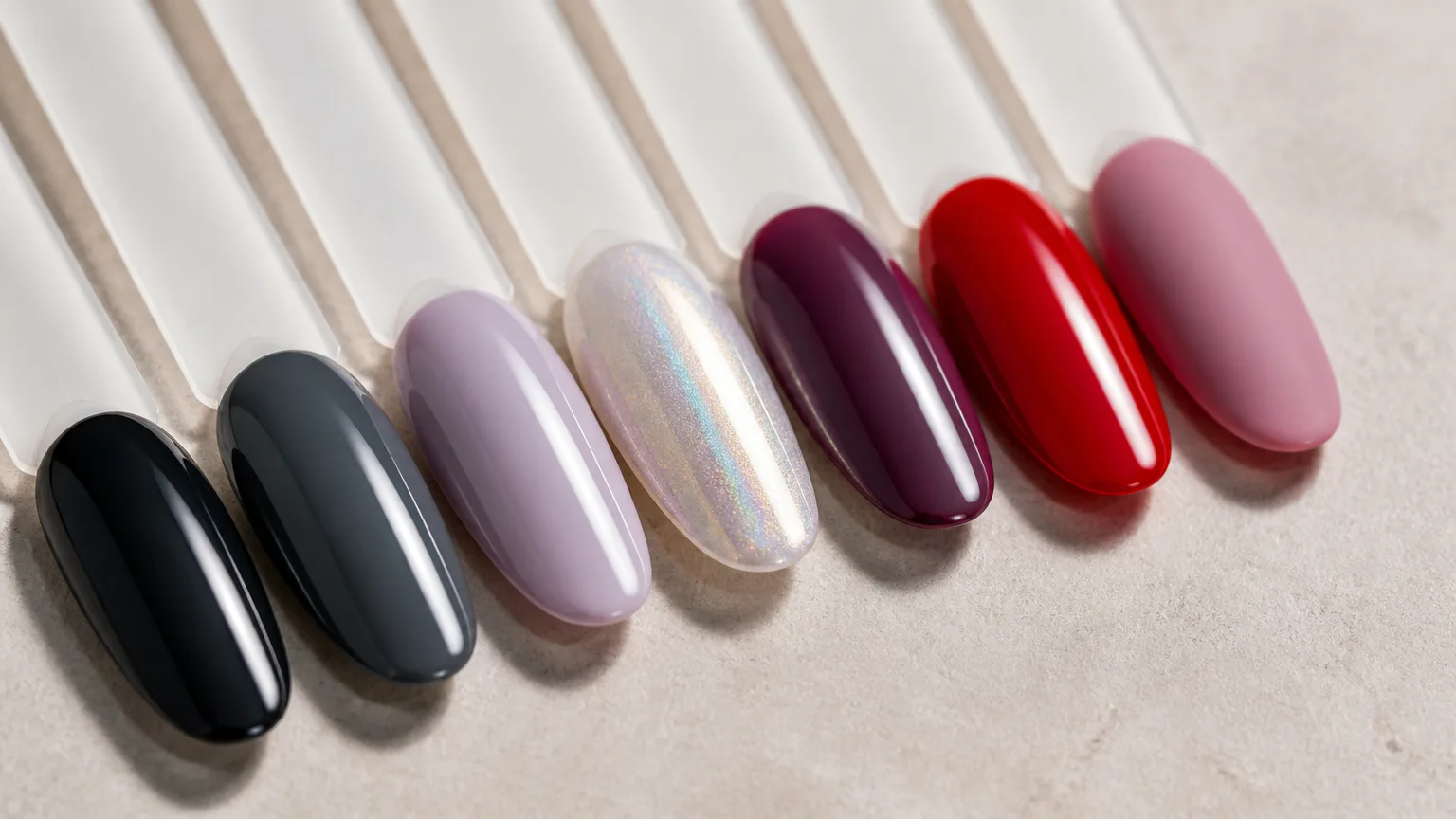
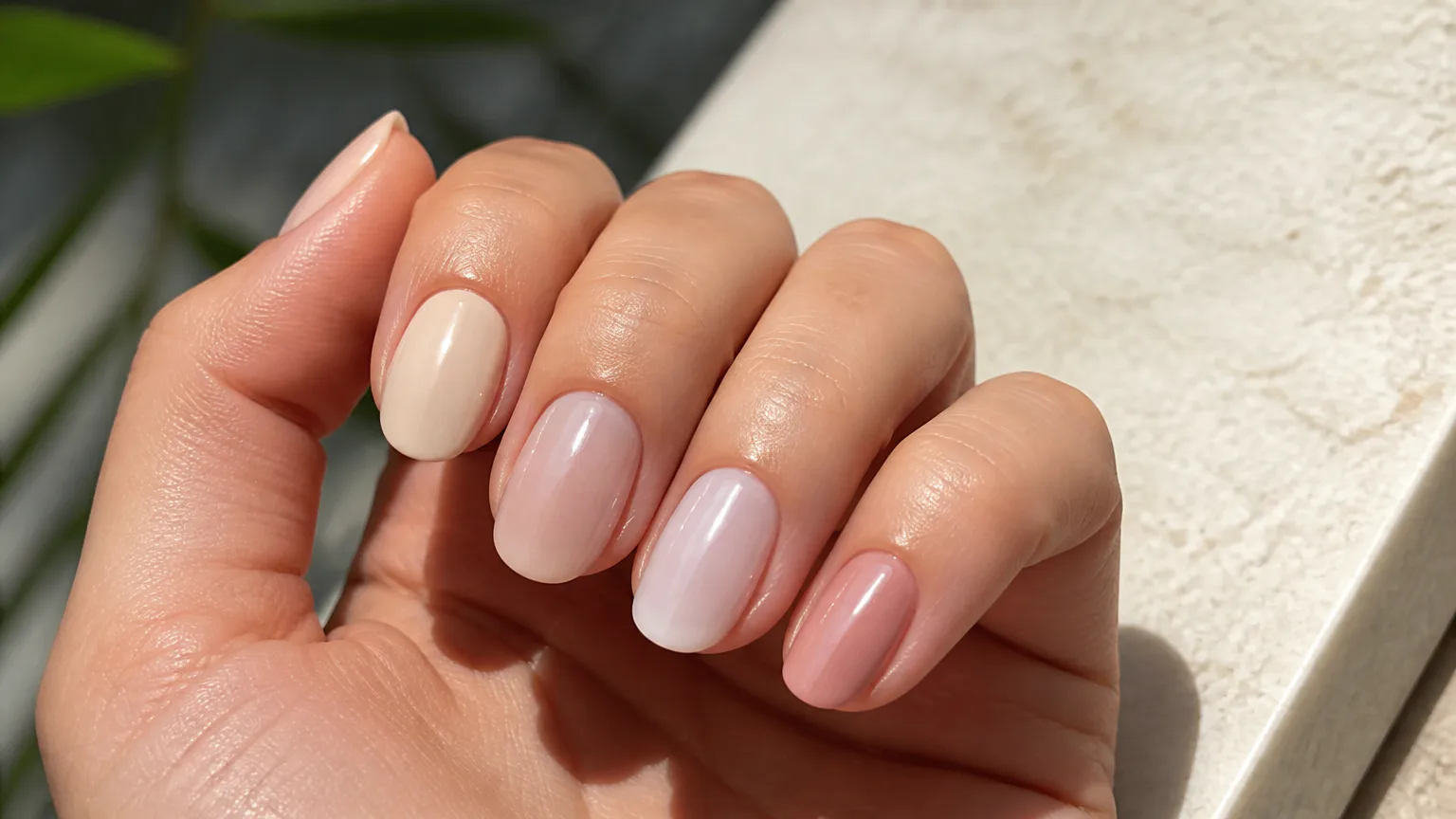
Crème is a reliable everyday choice. It gives the nails smooth, solid color without visible shimmer or glitter and usually becomes opaque in one or two coats. Sheer polish leaves the natural nail visible, which suits a clean, low-maintenance manicure. Milky polish adds a cloudy white or tinted veil and provides slightly more coverage than a sheer formula.
Jelly polish has more color than a sheer formula but remains translucent, creating a glossy, glass-like effect. Additional coats build its coverage. It also works well for layered nail art, including a jelly sandwich made with polish, a translucent layer of glitter, and another jelly layer. Crelly polish falls between jelly and crème, with more pigment but some of the depth and translucency of jelly.
Glossy describes the amount of shine rather than a specific level of coverage. Matte polish reflects very little light and has a flat, velvety appearance, while satin sits between matte and glossy. Suede and velvet are softer visual variations that suggest fabric or plush depth, although the exact result depends on the formula and lighting.
Sparkly and Reflective Finishes
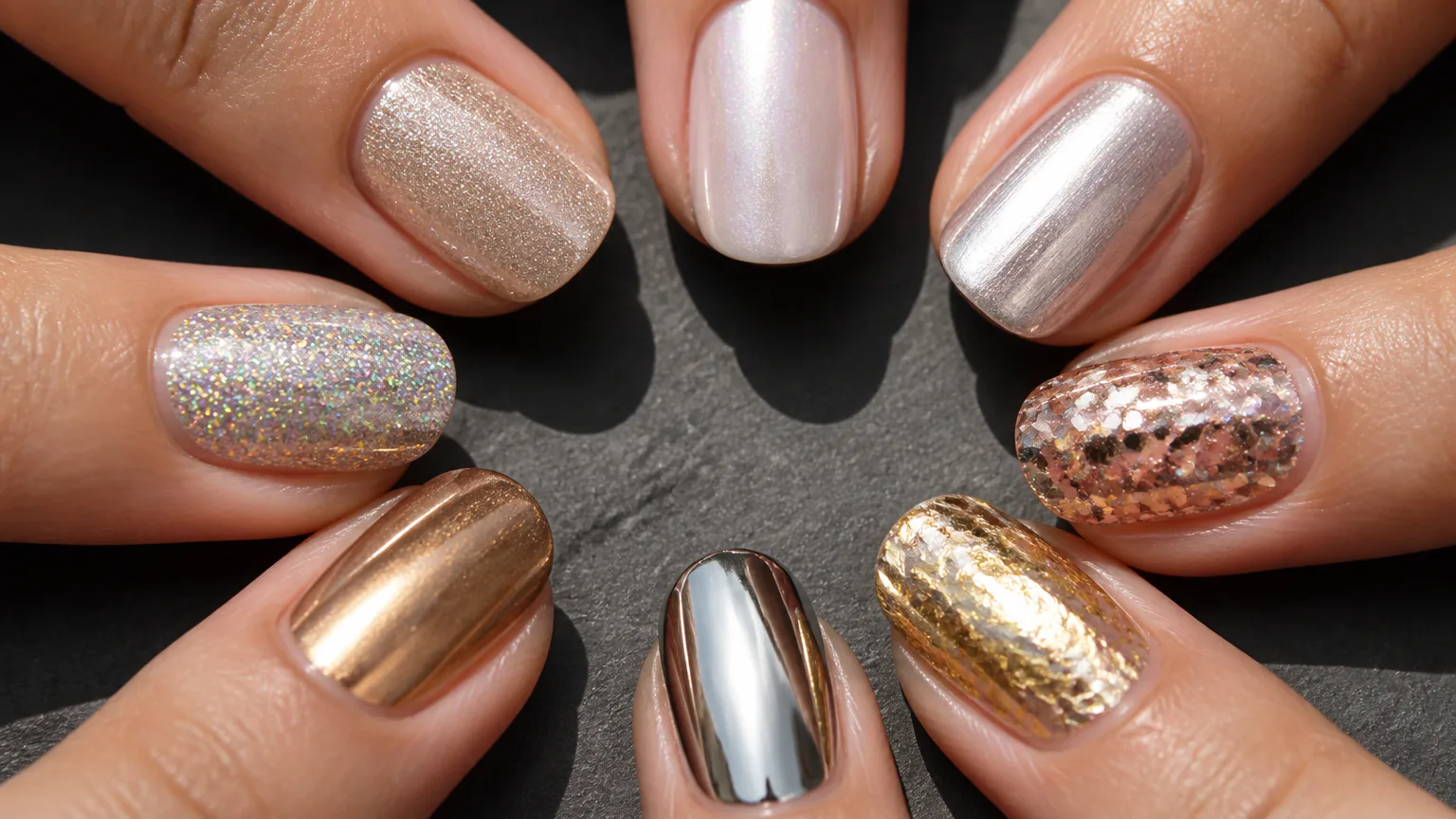
Shimmer contains fine reflective particles that create a soft glow without the obvious sparkle of glitter. Pearl has a gentler iridescent sheen. Frost produces a stronger pearly metallic effect and may show brushstrokes when it is applied unevenly. These finishes add dimension while usually remaining smooth to the touch.
Glitter contains reflective particles that may be fine, chunky, or mixed. It can sit in a tinted base or a clear base, so coverage ranges from transparent sparkle to a dense, opaque surface. Flake polish uses larger metallic or iridescent pieces. It is often worn as a topper over another color and may leave a slightly raised surface.
Metallic, foil, and chrome or mirror finishes all reflect light strongly, but the effects differ. Metallic polish resembles gold, silver, bronze, or another polished metal. Foil is brighter and more intensely reflective, while chrome or mirror creates the smoothest, glass-like metal effect. Chrome effects often come from dense lacquer or powder applied over a cured surface.
Color-Shifting and Specialty Finishes
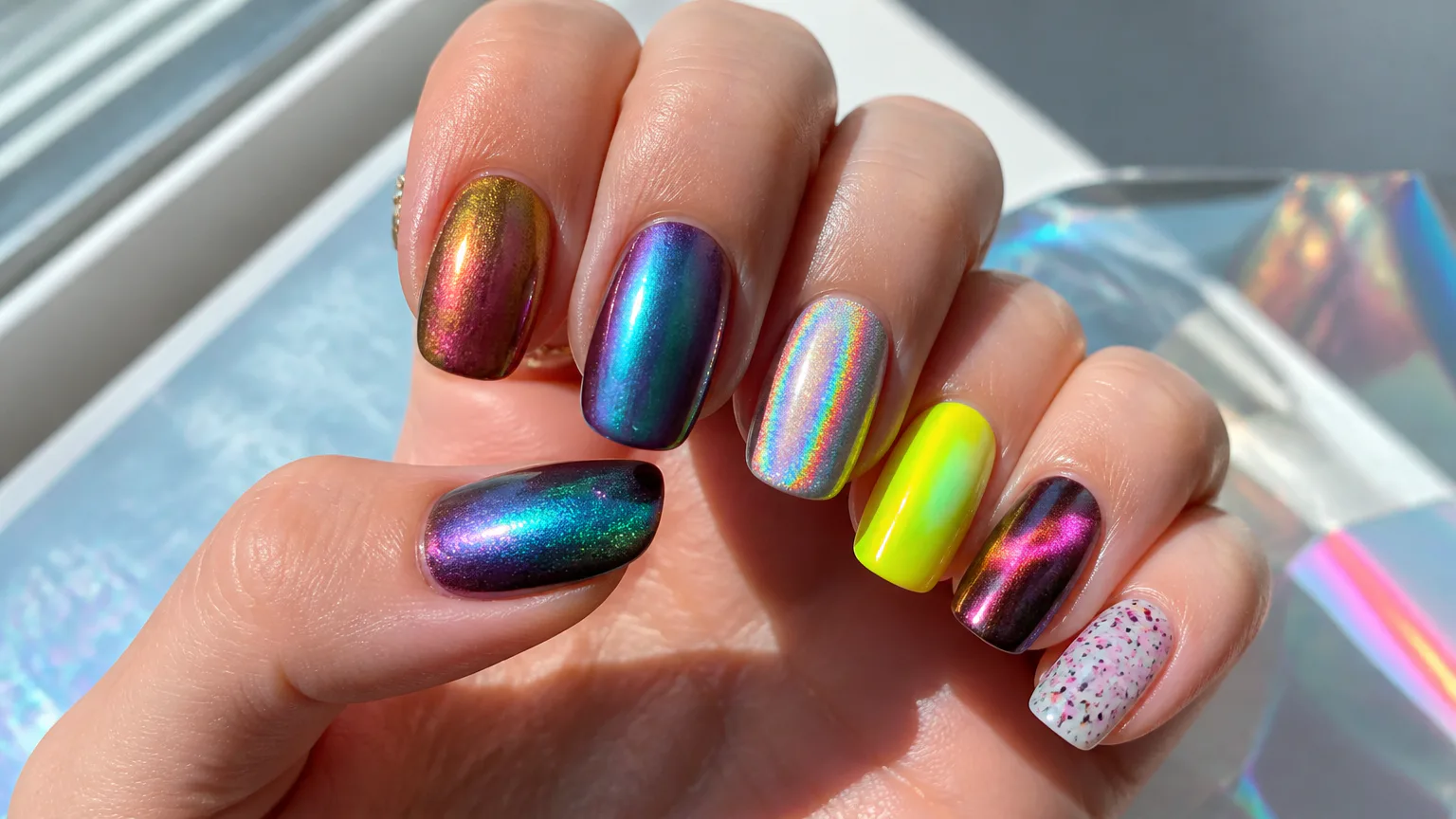
Duochrome polish shifts between two visible colors as the viewing angle changes. Multichrome moves through several colors, while iridescent polish creates a subtler rainbow or pearly shift. Holographic polish separates light into a prism-like rainbow effect, especially under direct light.
Neon polish uses highly saturated pigment and may react strongly under ultraviolet or blacklight. Magnetic or cat-eye polish contains magnetic particles. Holding a magnet over the wet coat creates a line, wave, or dimensional band before the polish sets. Keep the magnet close without touching the nail, and work on one nail at a time.
Thermal polish changes color with temperature, often producing a different shade at the nail tip or in cold conditions. Solar polish changes under ultraviolet sunlight. Textured, speckled, and caviar finishes change the physical surface as well as the color: textured polish feels grainy or raised, speckled polish contains contrasting spots, and caviar polish uses tiny beads to create a three-dimensional effect.
Finish Versus Polish Formula
A finish describes the visible result, while a formula describes how the product is applied and cured. Regular nail polish dries as solvents evaporate and commonly lasts about seven days, depending on nail condition and care. Gel polish can have a crème, glitter, shimmer, or other finish, but it hardens under a UV or LED nail lamp and commonly lasts around two weeks when properly cured and removed.
Acrylic and dip powder are enhancement systems rather than finishes. Acrylic sets into a durable nail enhancement and commonly needs maintenance after three to four weeks. Dip powder commonly lasts two to three weeks, with some formulas lasting up to a month. Builder gel is another enhancement or overlay system, and its surface can still be glossy, matte, metallic, or decorated.
Standard nail polish contains film-formers, resins, solvents, plasticizers, pigments, and dyes. Nitrocellulose is a common film-former. A base coat helps reduce staining and improves adhesion. A top coat helps reduce chipping and peeling and can add or change the final shine.
How to Choose Your Finish
Begin with the visual effect you want, then consider application and removal. Smooth crème or jelly polish is a useful starting point for a first manicure. Glitter, caviar, and heavily textured formulas take longer to remove and may catch on fabric. Matte finishes reduce shine but can make surface ridges more visible, and oils on the nail may change their appearance over time.
- For classic coverage: Choose crème or crelly.
- For visible natural nails: Choose sheer, milky, or jelly.
- For low shine: Choose matte, satin, or suede.
- For subtle dimension: Choose shimmer, pearl, or iridescent.
- For strong sparkle: Choose glitter, flake, or holographic.
- For a metal effect: Choose metallic, foil, or chrome.
- For nail art movement: Choose magnetic, duochrome, multichrome, thermal, or solar.
- For a raised surface: Choose textured, speckled, or caviar.
A matte top coat turns glossy polish into a matte finish, allowing you to change an existing manicure without changing the color. A glossy top coat increases shine and helps protect the polish from chips. Both can change the final appearance, so apply them after the color coats are even and sufficiently dry.
How to Apply and Layer Finishes
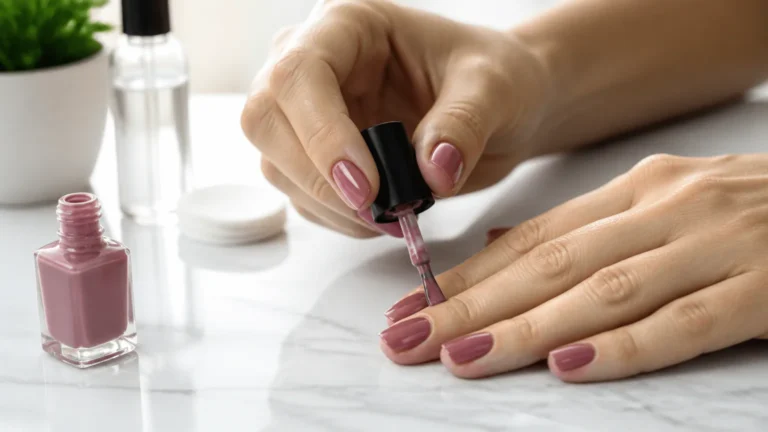
Preparation affects how evenly a finish applies and how long it wears. A traditional manicure takes about 30 to 50 minutes. Standard polish is usually dry to the touch in 15 to 20 minutes but may take up to 24 hours to fully harden.
- Clean the nails and remove oil, lotion, and old polish.
- Shape the free edge and gently smooth rough areas.
- Apply a thin base coat to improve adhesion and reduce staining.
- Apply two thin color coats, allowing each coat to settle before applying the next.
- Layer jelly polish over a dry glitter or flake layer for a deeper glass effect.
- Apply shimmer or flake polish over a crème color for a topper effect.
- Hold a magnet over wet magnetic polish before it sets.
- Seal the manicure with a compatible top coat.
Thin coats are more reliable than one thick coat, especially with crème, metallic, and glitter formulas. Lightly cap the free edge with color and top coat, but avoid flooding the cuticle area. Gel products require the correct lamp, coat thickness, and curing time listed for that formula.
How to Remove Each Finish Safely
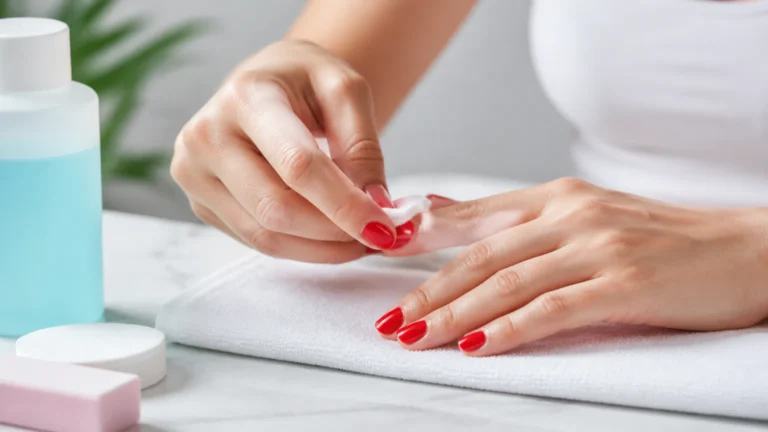
Regular crème, sheer, jelly, shimmer, and metallic polishes usually come off with standard remover and cotton. Saturate the cotton, hold it against the nail briefly, and wipe toward the tip instead of scrubbing across the surrounding skin.
- Soak cotton with acetone for stubborn glitter or flake polish.
- Place the cotton over each nail and wrap it with foil.
- Leave the wraps in place for about 5 to 8 minutes.
- Slide the softened polish away gently with the cotton.
- Repeat briefly if particles remain instead of scraping the nail.
- Wash your hands and apply cuticle oil or a rich hand cream.
Gel polish should be filed lightly to break the surface seal and soaked off with acetone according to the product system. Do not peel or force gel, acrylic, or dip powder from the natural nail; picking can remove layers of the nail with it. Textured and caviar finishes may need extra soaking and careful handling around raised particles.
Conclusion
Choose a finish by deciding how much coverage and shine you want, then consider texture, layering, and removal. Crème is a dependable everyday option, jelly adds translucent depth, matte changes how the nail reflects light, and glitter, chrome, and color-shifting formulas create stronger effects. Next, try how to apply nail polish, best sheer pink nail polish, or browse the brands hub.